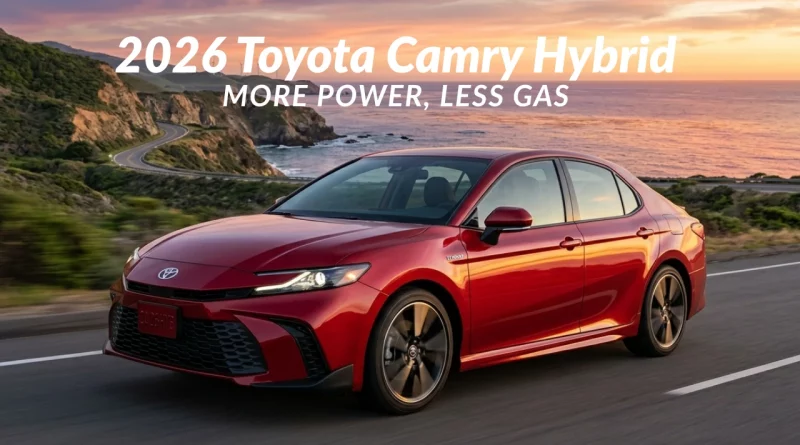
2026 Toyota Camry Hybrid – More Power, Less Gas
The redesigned 2026 Toyota Camry Hybrid solidifies its position as the undisputed leader of the mid-size sedan segment, starting at an attractive $29,000 and delivering up to an impressive 52 MPG. By moving exclusively to a hybrid powertrain for this generation (XV80), Toyota has shifted the focus toward thermal efficiency, standard Toyota Safety Sense 3.0 tech, and an available electronic AWD option. This guide provides a deep technical analysis of why this specific architecture changes the game for modern drivers.
The Heart of the Machine: A25A-FXS Engine Deep Dive
The core of every 2026 Toyota Camry is the 2.5-liter Dynamic Force 4-cylinder engine (A25A-FXS). This is not a carryover engine but a highly optimized unit designed for the Toyota Hybrid System 5 (THS 5).
Technical Engine Specifications:
- Type: Inline 4-cylinder, DOHC 16-valve.
- Cycle: Atkinson Cycle (optimized for efficiency by keeping intake valves open longer).
- Injection System: D-4S Dual Injection (combines direct and port injection to optimize combustion under all load conditions).
- Valve Train: VVT-iE (Variable Valve Timing-intelligent by Electric motor) on the intake and VVT-i on the exhaust.
- Compression Ratio: 14.0:1 (exceptionally high for increased thermal efficiency).
- Thermal Efficiency: Reaches a world-class 41%, meaning more energy from fuel is converted into motion rather than heat.
Power Output and Motor Configuration
The 2026 Camry utilizes two different power configurations depending on the drivetrain:
- Front-Wheel Drive (FWD): Features two permanent magnet synchronous motors.
- Net Combined Horsepower: 225 hp.
- Electronic On-Demand All-Wheel Drive (AWD): Adds a third dedicated electric motor to the rear axle.
- Net Combined Horsepower: 232 hp.
- Functionality: The rear motor operates independently to provide instant traction on slippery surfaces without a mechanical drive shaft, reducing weight and friction.
5th-Gen Toyota Hybrid System (THS 5) Improvements
For the 2026 model year, the THS 5 system has been refined to be lighter and more compact. The power control unit (PCU) has been redesigned to reduce electrical losses, and the Lithium-ion battery is now more energy-dense, allowing for more frequent EV-only operation at low speeds.
| Component | Improvement in 2026 Model |
| Transaxle (e-CVT) | More compact design with reduced internal friction. |
| Rear Motor (AWD) | Higher torque output for better off-the-line acceleration. |
| Battery Chemistry | Optimized Lithium-ion cells for faster charging/discharging. |
What’s New for the 2026 Model Year?
While the 2025 model introduced the new generation, the 2026 Toyota Camry brings several critical refinements:
- The Nightshade Edition: A new trim level featuring 19-inch matte-black wheels, Midnight Black Metallic accents, and a sport-tuned suspension.
- Infotainment Upgrade: A new 12.3-inch digital gauge cluster is now standard on SE Upgrade and XLE/XSE trims, paired with an available 14-inch Toyota Audio Multimedia touchscreen.
- Enhanced Comfort: Revised seat bolstering and upgraded acoustic glass in the front windows to further reduce wind noise.
- Color Palette: New premium finishes including Dark Cosmos and Ocean Gem have been added to the lineup.
Fuel Economy and Performance
Despite the power increase, the 2026 Camry remains a fuel-economy leader. Efficiency varies by trim due to wheel size and weight:
- LE FWD: Up to 51 MPG Combined (53 City / 50 Highway).
- SE / XLE / XSE: Approx. 44–47 MPG Combined (due to 18″ and 19″ wheels).
- 0-60 MPH Performance:
- FWD: ~7.2 seconds.
- AWD: ~6.9 seconds.
Safety and Technology
Every 2026 Camry comes standard with Toyota Safety Sense 3.0 (TSS 3.0), which includes:
- Pre-Collision System with Pedestrian Detection (now with improved motorcycle and bicycle detection).
- Full-Speed Range Dynamic Radar Cruise Control.
- Proactive Driving Assist: Provides gentle braking/steering support into curves or to maintain distance.
Pricing and Trims
The 2026 Toyota Camry Hybrid starts at approximately $29,000 for the base LE trim. Options expand through SE and XLE, up to the distinctive Nightshade Edition, which adds exclusive design accents. At the top end, the XSE Hybrid AWD can exceed $36,000, depending on market and selected packages. This pricing strategy keeps Camry competitive in the midsize sedan segment, balancing affordability with advanced technology.
Competitors
While the Camry continues to set the benchmark for hybrid sedans, several rivals challenge its position:
- Honda Accord Hybrid (2026) — similar fuel economy, with a stronger emphasis on sporty driving dynamics and interior refinement.
- Hyundai Sonata Hybrid — stands out with bold styling and an expanded suite of infotainment features.
- Kia K5 Hybrid (upcoming refresh) — focuses on value pricing and extended warranty coverage.
- Nissan Altima e-Power — introduces a new series-hybrid system that could rival Toyota’s proven approach.
The Camry maintains its edge through a balanced formula: high efficiency, long-term reliability, and Toyota’s extensive dealer network.
Summary
The 2026 Toyota Camry is a masterclass in hybrid engineering. By perfecting the 2.5L Dynamic Force engine and integrating the THS 5 system, Toyota has created a vehicle that offers near-V6 performance levels with compact-car fuel consumption. It remains the safest and most logical choice for the modern sedan buyer.
Latest updates on car trends and tech! Check out this WiKi Overview: Link